Last Updated on November 21, 2026 by YeJahan
YEJAHAN REPORT
Reported attacks on commercial shipping in and around the Strait of Hormuz climbed higher in October and November than during any previous months since the conflict between the United States, Israel, and Iran erupted in late February, according to maritime security data.
Analysts say the intensified campaign is designed to disrupt U.S.-facilitated workarounds aimed at keeping crude oil flowing through the vital waterway despite an Iranian-declared blockade.
The United Kingdom Maritime Trade Operations Centre (UKMTO) logged 31 attacks in and around the strait in October and approximately 19 more through Nov. 18. By comparison, the agency recorded 53 incidents across the entire seven-month span from March through September, averaging 10 to 15 incidents a month across the strait and surrounding gulfs.
The United Nations’ International Maritime Organization (IMO) reported slightly more conservative figures, confirming 34 attacks in the Strait of Hormuz area during October and November, still a sharp spike from the roughly 50 incidents it tallied there between March and September. In total, the IMO has documented 138 vessel attacks across the Middle East since the war began.
UKMTO positional data shows that most targeted tankers were struck in the far southern section of the strait, hugging the Omani coastline.
“Iran’s objective remains to keep the Omani route, which is described as a U.S.-facilitated route, a very high-risk passage and to keep the energy recovery inconsistent,” said Noam Raydan, a senior fellow at the Washington Institute for Near East Policy.
To bypass Tehran’s blockade, Washington and its regional partners rely on “ship-to-ship” (STS) transfers, according to Sina Toossi, a senior fellow at the Center for International Policy. Under this arrangement, smaller tankers slip through the strait with their tracking transponders switched off before transferring their crude onto larger vessels waiting safely on the other side.
“Washington and its regional partners have found ways to keep oil flowing through the Strait of Hormuz,” said Hamidreza Azizi, senior Iran analyst at the International Crisis Group. “Tehran now seems determined to make these arrangements more costly and less reliable.”
Toossi described the escalation as a “cycle of adaptation and counter-adaptation,” noting that Iran is trying to render the STS workaround financially and operationally unviable. “Iran’s broader objective is to demonstrate that normal oil exports cannot continue while the U.S. maintains its blockade of Iran, and to generate enough economic pressure to force Washington to negotiate an end to the conflict,” he said.
Since April 13, with a brief pause between June 18 and July 13, the U.S. Navy has enforced a blockade intercepting Iranian and Iran-linked vessels entering or leaving the Gulf of Oman.
Iranian operations have also expanded to infrastructure and stationary vessels far from the transit lanes. On Nov. 8, satellite imagery and video confirmed an Iranian strike on the Omani island of Didamar inside the strait, which houses radar and satellite communications equipment. Iranian state media claimed forces struck “enemy navigation aid systems.” Oman, a U.S. partner, declined to comment.
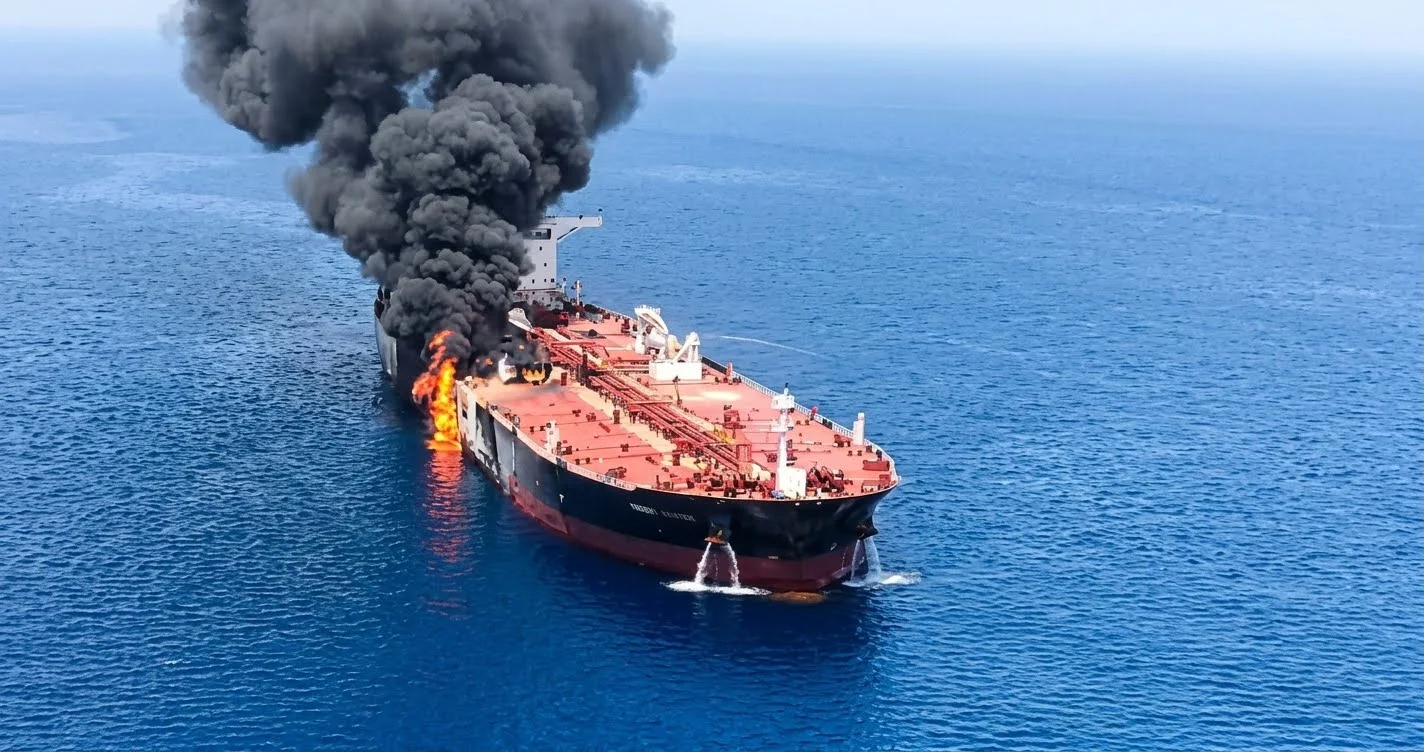
Weeks earlier, strikes hit a supertanker that was not even attempting to transit the waterway. The Panama-flagged Gem No. 2, loaded with two million barrels of Saudi crude according to maritime intelligence firm Kpler, had sat anchored off the coast of the United Arab Emirates in the Persian Gulf for nearly five months, one of hundreds of ships trapped in the region since February.
Two crew members confirmed the vessel never attempted to cross the strait. According to crew videos, a single drone struck the tanker on Oct. 9, followed by at least three more on Oct. 10, igniting a massive fire that forced the crew to abandon ship. Hours later, the Islamic Revolutionary Guard Corps (IRGC) claimed online that the vessel had hit a naval mine while using an “unauthorized” route through the strait.
Satellite imagery captured days later confirmed the abandoned tanker remained off the UAE coast, well outside the Strait of Hormuz. Additionally, drone warfare researcher Fabian Hinz examined crew photos of the Oct. 9 wreckage and identified it as a jet-powered, Iranian-built Hadid-110 drone.
US strikes Iranian missile site on Qeshm Island as Gulf allies intercept retaliatory drone attacks
Samir Madani, co-founder of TankerTrackers.com, noted that Gem No. 2 had left its location transponders active prior to the strikes, broadcasting its position publicly and making it an easy target. Azizi suggested Tehran may be deliberately targeting idle supertankers to discourage alternative shipping arrangements.
Both analysts warned that Tehran’s strategy carries severe global risks.
“Ultimately, the objective goes beyond disrupting oil exports,” Azizi said. “Iran is trying to demonstrate that the United States cannot guarantee maritime security in the Persian Gulf despite its overwhelming naval superiority.”
Toossi cautioned that the standoff threatens to spiral into a broader economic shock: “The danger is that this escalating contest will produce a much wider disruption of regional shipping and energy infrastructure, with even greater consequences for the global economy.”
Copyright YeJahan News Network, 2026