
Last Updated on October 26, 2026 by YeJahan
YEJAHAN DESK
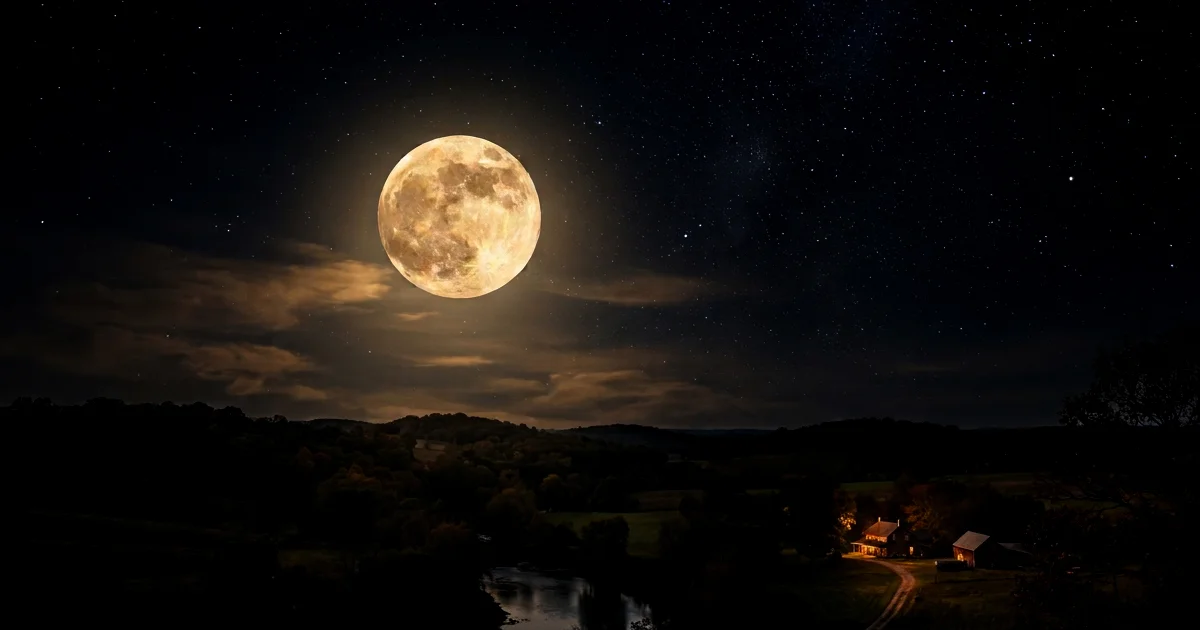
Arriving just a month after the autumn equinox, the moon will rise notably early, appearing on the horizon at sunset before reaching peak illumination at 12:12 a.m. ET today (Monday, October 26). Observers will notice a distinct orange hue as the lunar orb hangs low in the sky. This atmospheric effect occurs because moonlight must travel through a denser layer of air at lower angles, scattering shorter blue and violet wavelengths and allowing deeper orange and red tones to dominate.The “Hunter’s Moon” moniker stems from Native American traditions, marking the time when hunters used the prolonged, bright moonlight to track wildlife and store provisions for the winter. It follows September’s Harvest Moon, which historically signaled the period for gathering crops.
While the moon will return to its familiar silvery appearance over the coming months, careful observers can detect shifts in its visible face. Noah Petro, a project scientist for NASA’s Artemis III mission, notes that these subtle variations in shading are driven by differences in the moon’s surface composition and geological age.
Beyond its own visual appeal, this weekend’s full moon offers an ideal reference point for locating Saturn, which is currently entering its peak viewing season. The ringed planet will remain exceptionally bright and visible to the naked eye for several months.
On October 26 (today), Saturn will position itself just a few degrees south of the full moon. Although the intense lunar glare may slightly dim the planet’s luster, the moon’s proximity makes Saturn remarkably easy to identify. Observers need only look toward the moon to find a steady, golden light resting beside it.
Saturn distinguishes itself from actual stars by its light profile; it shines with a solid, unwavering glow rather than a twinkle, which is caused by atmospheric turbulence. To the unaided eye, the planet appears not as a ringed ball, but as a prominent yellowish-white point of light.
The planet rises in the late afternoon and becomes clearly visible as twilight fades, reaching its highest point in the sky between 10:30 p.m. and 11:00 p.m. PKT. For observers in Lahore or Islamabad, 10:30 p.m. offers the prime viewing window, while those in Karachi will find the best conditions around 11:00 p.m.
Shining at a relatively bright magnitude of roughly 0.4, Saturn can be easily spotted even within major urban centers like Karachi, Lahore, and Islamabad, provided the skies remain clear of heavy smog and cloud cover. For absolute confirmation, stargazers can utilize mobile applications like SkyView Lite, which use augmented reality to overlay planet names and constellation lines directly onto a smartphone’s camera feed.
Copyright YeJahan News Network, 2026