Last Updated on November 9, 2026 by YeJahan
SARIM NAFEES
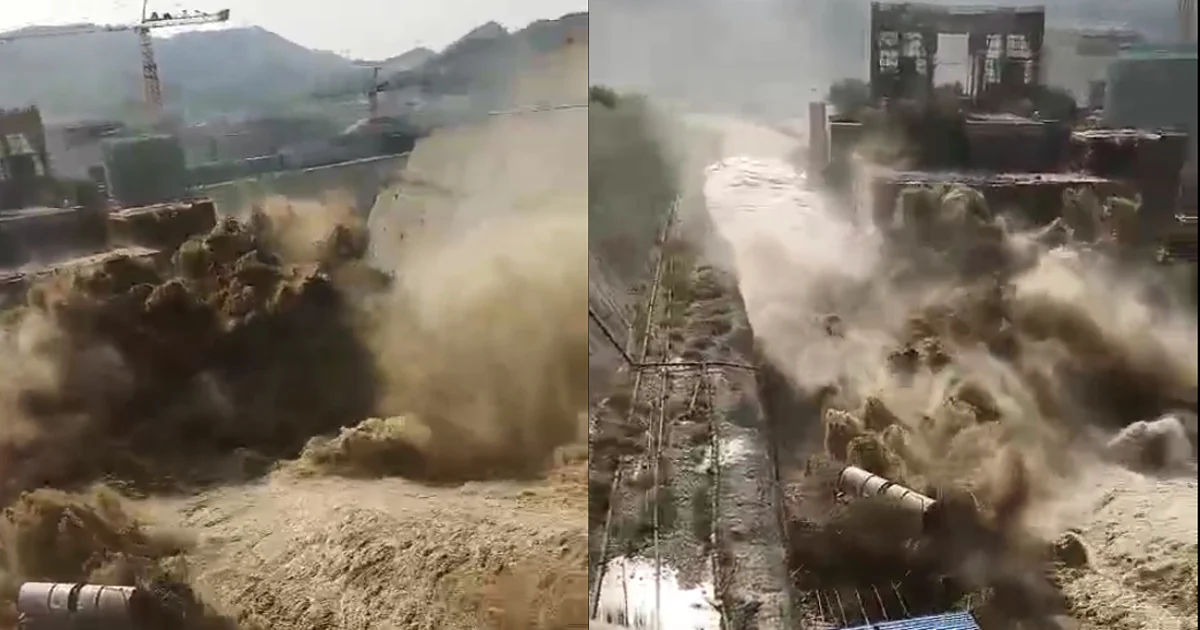
HARIPUR, Khyber Pakhtunkhwa (Nov 9): Construction work on the World Bank and Asian Infrastructure Investment Bank (AIIB)-backed Tarbela Fifth Extension Hydropower Project (T5) has been suspended indefinitely after a rock collapse triggered flooding inside Tunnel 5 on Monday morning.
All local and foreign personnel, including Chinese engineers and workers, were safely evacuated from the site, and officials confirmed that the main dam structure faces no threat.
The incident occurred at approximately 10:30 AM, sparking initial reports that a protective embankment had breached. However, relevant authorities swiftly dismissed those claims, characterizing the event as an accidental cave-in during routine excavation.
According to a statement issued by the Water and Power Development Authority (WAPDA), a weak rock section gave way while crews were excavating the project’s second-bench connecting tunnel. The collapse allowed water from the intake pit to rush into the connecting tunnel and spill into the under-construction powerhouse area.
During excavation of the 2nd Bench Connecting Tunnel at Tarbela 5th Extension, weak rock collapsed causing Intake Pit water to enter the tunnel. All workers are safe. No damage to main tunnel, powerhouse, tailrace or switchyard. Reports of tunnel collapse are incorrect. https://t.co/XuPKYH0eRG
— WAPDA (@wapda_pr) November 9, 2026
WAPDA maintained that the main tunnel, powerhouse structure, tailrace culvert, and switchyard remain completely intact. The authority added that water has since been fully drained from the intake pit.
Addressing concerns over potential flooding in surrounding areas, Haripur Deputy Commissioner Wasim Ahmad told YeJahan News Network that the main Tarbela Dam embankment suffered no damage and that the situation is entirely under control.
“No emergency has been declared, and there is zero threat to any downstream populations,” Ahmad said, confirming that all Chinese nationals working on the site are safe. He noted that a WAPDA technical team is currently on the ground assessing the structural integrity of the excavation site.
WAPDA has confirmed that all workers were safely evacuated following a water inflow incident during excavation work at the Tarbela 5th Extension Hydropower Project @MoWP15 @wapda_pr #TarbelaDam #News #RadioPakistan https://t.co/QzGNOVUNK3 https://t.co/m1gSH38to9
— Radio Pakistan (@RadioPakistan) November 9, 2026
Despite official assurances, local sources indicate that water seepage has caused minor landslides along parts of the adjacent hillside and tunnel walls. To alleviate pressure and stabilize the site, authorities are reportedly considering lowering the reservoir’s water level.
Following the administration’s decision to lower the reservoir’s water level, urgent directives were issued to all riverine communities to relocate to safer ground without delay.
In a public advisory, the Assistant Commissioner of Ghazi stated that water discharge from Tarbela Dam is expected to exceed 150,000 cusecs. Consequently, all settlements in the immediate vicinity of the dam and downstream areas have been instructed to move out along with their livestock to prevent any loss of life or property.
To enforce the evacuation and manage the emergency response, police control rooms have been placed on high alert. Authorities have also directed local youth groups and community volunteers to remain on standby to assist residents with the relocation effort.
International Financing and Project Delays
The Tarbela Fifth Extension (T5) hydropower project, built to add roughly 1,530 megawatts of clean electricity to Pakistan’s national grid, is leaning heavily on international lenders as construction hurdles drive up its price tag.
Originally budgeted at $807 million, the expansion launched with major backing from multilateral banks—including a $390 million loan from the World Bank and $300 million from the Asian Infrastructure Investment Bank (AIIB). In May 2021, the Water and Power Development Authority (WAPDA) awarded the $354.6 million civil works contract to China’s Power Construction Corporation (POWERCHINA).
Since then, the project has hit repeated snags. Regulatory holdups over No Objection Certificates (NOCs) from the Indus River System Authority (IRSA) and seasonal reservoir restrictions have slowed work on the ground. Those setbacks have pushed the completion date from its original five-year timeline to 2027 and triggered steep cost escalations.
To cover the overruns and keep the expansion moving, the World Bank approved another $300 million in financing this past June.
Systemic Oversight Concerns
Monday’s technical setback comes just months after federal auditors raised red flags over project planning and execution within Pakistan’s water and power sectors.
In June this year, the Auditor General of Pakistan (AGP) released its 2025–26 Audit Report, uncovering extensive financial mismanagement, weak governance, and deep-rooted inefficiencies across the Ministry of Water Resources and its attached departments, including WAPDA, IRSA, and the Federal Flood Commission (FFC).
Based on scrutiny of the 2024-25 financial accounts, the Directorate General Audit (Water Resources) flagged widespread irregularities in contract management, procurement, and financial discipline, pointing to recoverable losses exceeding Rs7.02 billion.
Two toddlers killed, five injured as vehicle plunges into Malakand ravine
Crucially, the AGP observed that several major development initiatives were launched without adequate feasibility studies, thorough planning, or detailed engineering designs, a lack of foundational groundwork that auditors warned has repeatedly led to execution complications, costly delays, and operational hazards.
Copyright YeJahan News Network, 2026